After the Final Whistle: What Happens to 115 Years of History When United Moves Out |
Old Trafford has been Manchester United's home since 1910. With a proposed 100,000-seat stadium roughly 350 metres away, what becomes of the Theatre of Dreams? |
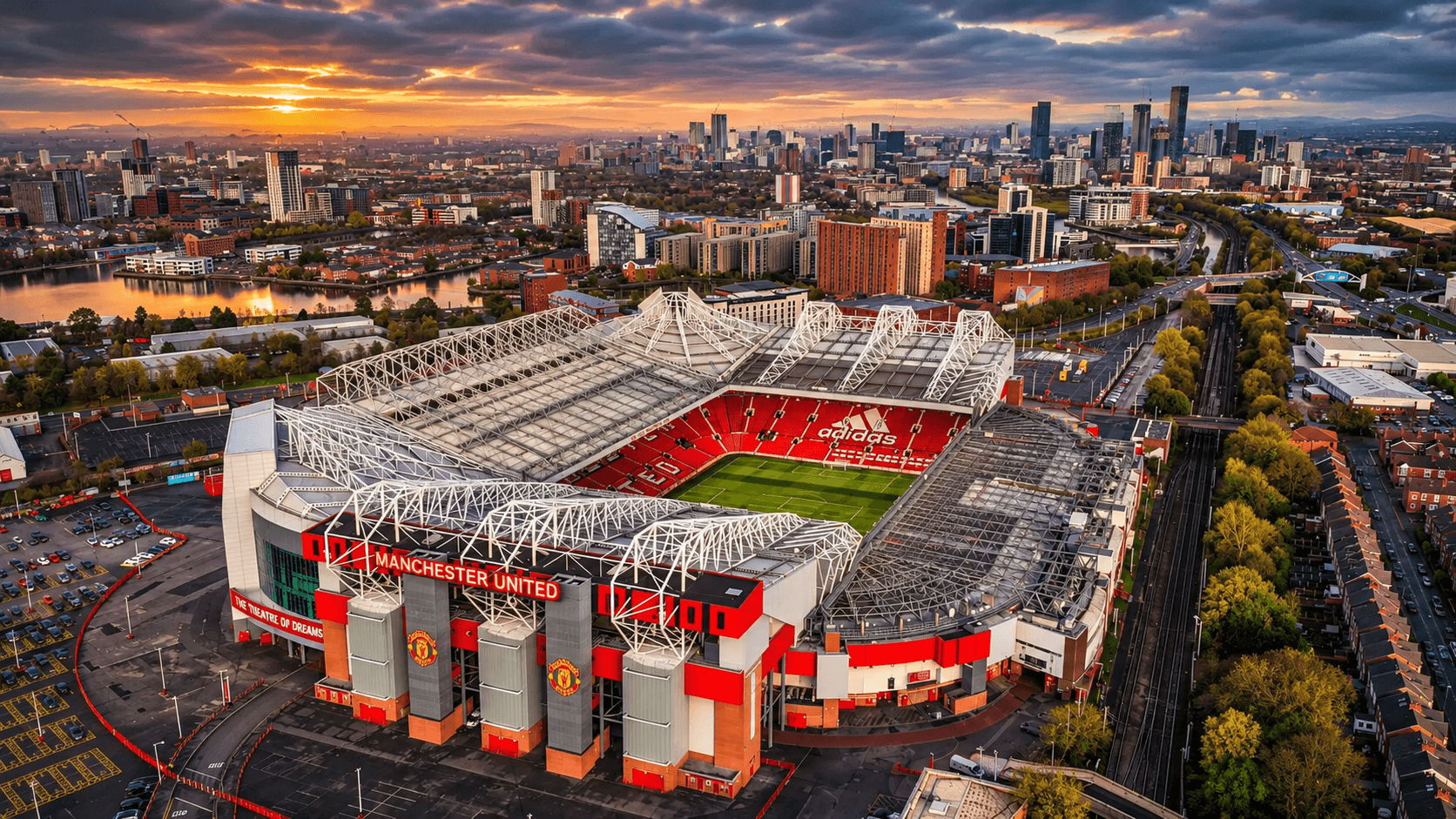 Old Trafford against the Manchester skyline — an AI-enhanced artistic interpretation based on an existing (original source unidentified) aerial photograph. |
The plans are taking shape. Manchester United has acquired the majority of the land needed for a proposed new 100,000-seat stadium, including a 25-acre site at Trafford Wharfside. The club's initial concept, developed with Foster + Partners, envisages the largest club football stadium in the UK. But the final design, planning approval, funding and opening date are not yet settled. For more than 115 years, Old Trafford has been more than a football ground. It has been a stage for legends, a landmark in Trafford, and a place where generations of families have shared moments they'll never forget. So if United eventually moves those roughly 350 metres, what happens to the old place? The Current Answer: Nobody Knows Yet That might sound evasive, but it is the honest answer. In July 2026, Manchester United stated explicitly that no decision had been made regarding the future of the existing Old Trafford stadium. Supporter engagement on the new ground is continuing. Several possibilities have been discussed publicly, but none should be mistaken for an agreed plan. Keep it, reduced in size. One much-discussed idea is a smaller ground for the women's team, academy football or heritage uses. Reports have suggested reducing capacity substantially, but no 20,000–30,000-seat scheme has been formally approved. Repurpose it. The existing site could potentially form part of a wider mix of community, commercial or other uses within the Trafford Wharfside regeneration area. No specific redevelopment of the old ground has been confirmed. Demolition. The possibility cannot be dismissed, but nor has the club announced that Old Trafford will be demolished. Its fate remains undecided. What About Listed Status? Old Trafford is not generally identified as a nationally listed stadium. Any formal protection would depend on the statutory listing process, not simply on a petition or the strength of public feeling. The ground has changed substantially since opening in 1910. Its four principal stands are the Sir Alex Ferguson Stand, the Sir Bobby Charlton Stand, the Stretford End and the East Stand. There is no 'Ronaldo Stand', and the Sir Bobby Charlton Stand has not undergone the recent major expansion described in some accounts. The heritage argument is nevertheless powerful. This is where Sir Bobby Charlton played, where Eric Cantona became an icon, and where Wayne Rooney scored his famous overhead kick against Manchester City. Supporters' memories are not erased by changes to brickwork. The Practicalities The club's stated construction estimate has been around four to five years once work begins, but that is not the same as a confirmed completion date. Preparatory work, design, funding, planning permission and the remaining land arrangements all matter. The proposed site is approximately 350 metres north-west of Old Trafford. Building nearby may allow United to continue using its current home during construction, and avoiding disruption is an important consideration. But matchday arrangements for the full construction period have not yet been finalised publicly. In March 2026, Collette Roche, then leading the new stadium development, made clear that the club had not announced an opening date. By July, United was still consulting on the masterplan and stadium design. |
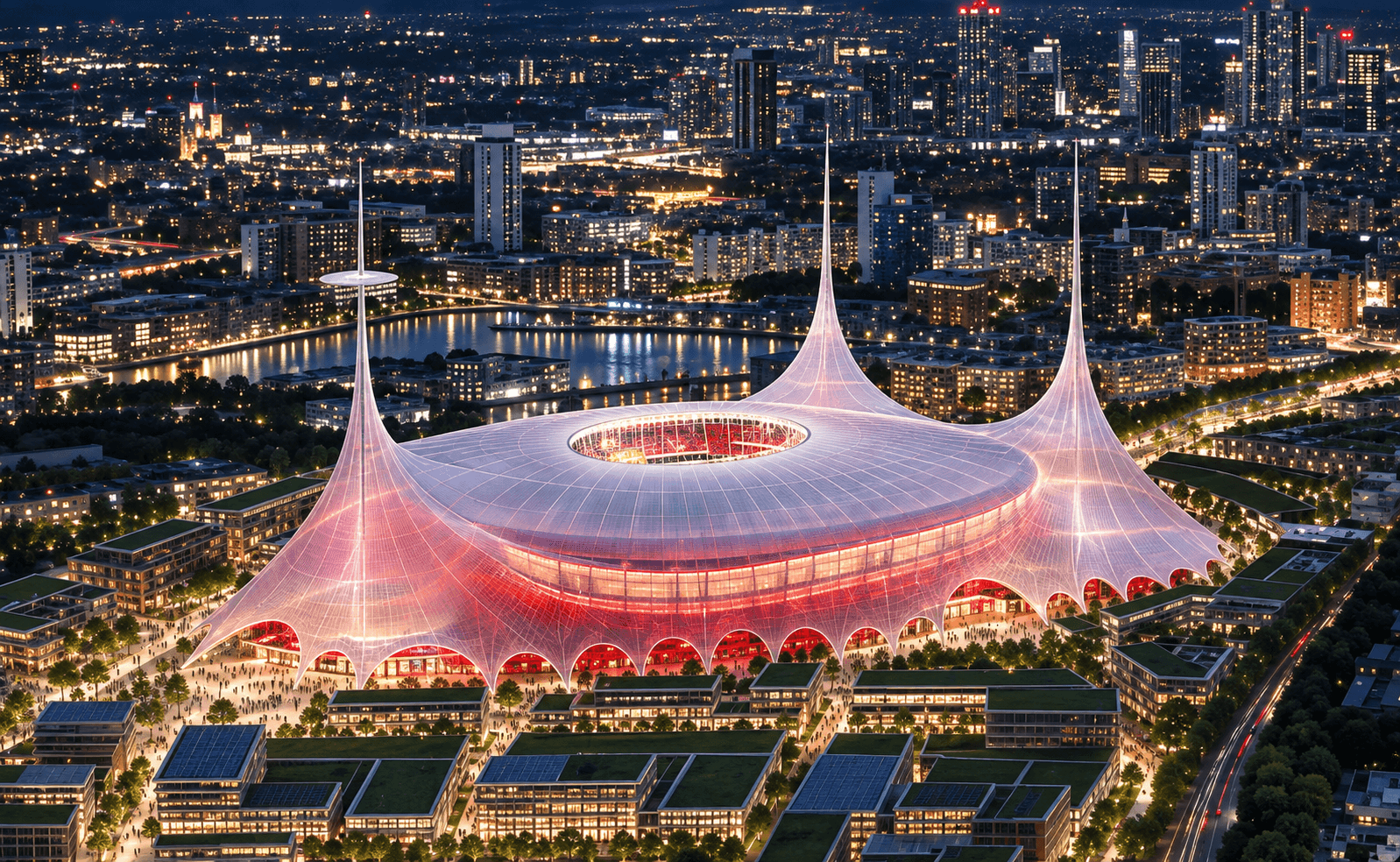
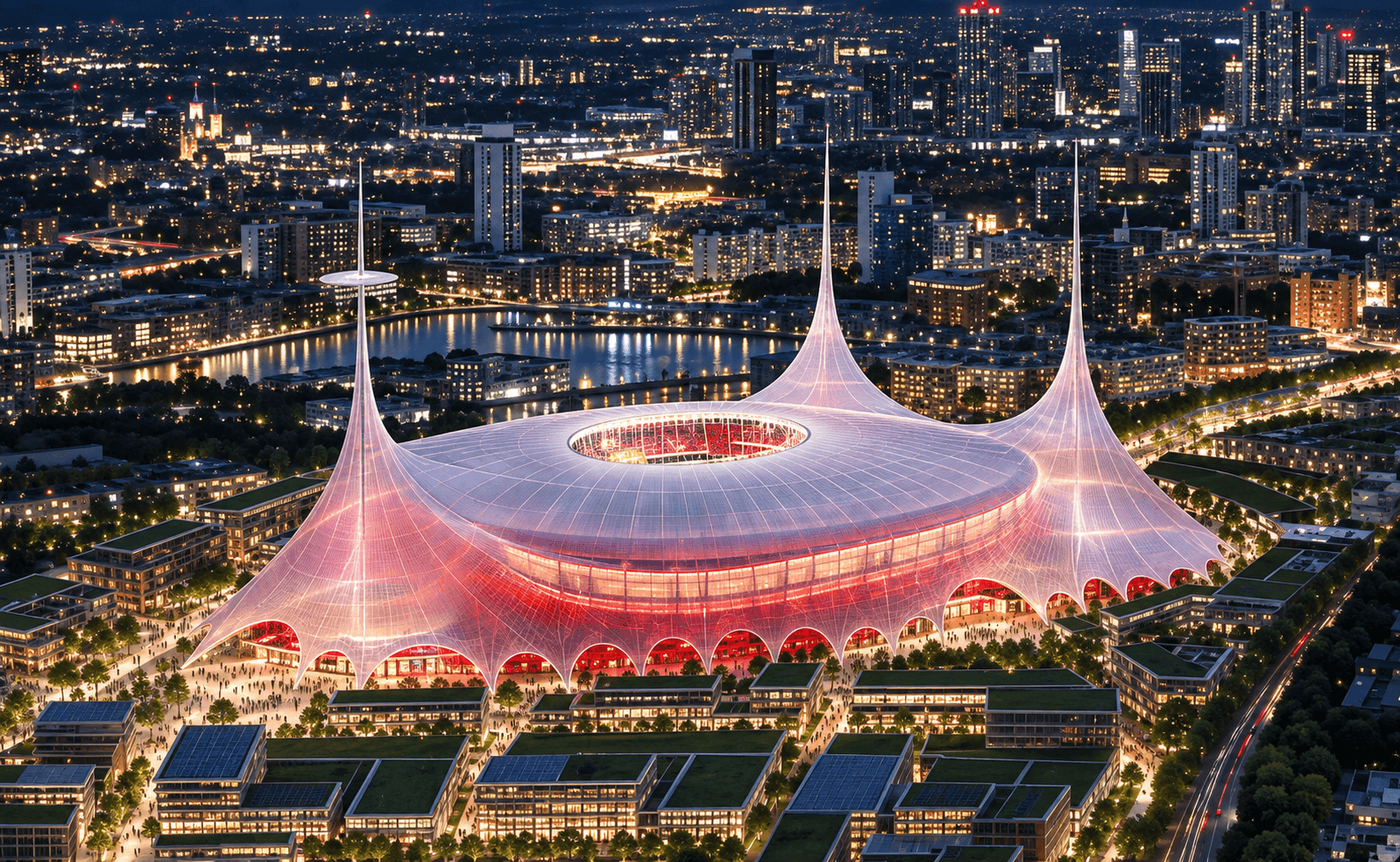 "Prototype AI-generated artist's impression of the proposed stadium district” |
What This Means for Trafford Whatever happens to the old stadium, United's plans sit within a much larger regeneration vision for Trafford Wharfside. The draft masterplan covers around 150 hectares and sets out ambitions for up to 15,000 homes and 48,000 local jobs. Those are projections for the wider development, not completed outcomes.
The often-quoted £7.3 billion figure refers to a potential annual contribution to the UK economy from the wider regeneration vision; it is not a confirmed £7 billion construction budget. Separate developments elsewhere in Trafford, including Therme Manchester and Trafford Waters, form part of the area's wider transformation but should not be presented as a single funded stadium scheme.
Old Trafford's future, whatever form it takes, will be part of a wider discussion about land, heritage, transport, jobs and community life.
The Bottom Line The Theatre of Dreams is not closing tomorrow. United continues to play at Old Trafford, and the club has not announced a final season there. Earlier hopes of a new stadium around 2030 have given way to a more cautious timetable; the Trafford Wharfside masterplan places the stadium in a 2031–2035 phase, and United has discussed an ambition to be ready for the 2035 Women's World Cup.
A smaller, heritage-minded Old Trafford could be one outcome, but it would be speculation to call it the most likely. Demolition, adaptation and other forms of redevelopment remain possibilities until the club and relevant authorities set out a decision.
One thing is certain: whatever happens, more than a century of history does not simply disappear. The buildings may change, but the memories will stay. |
Editorial Note — Plans and Projections This article distinguishes confirmed steps, including land acquisition and the proposed site, from concepts and projections. As of 20 November 2026, Manchester United has not confirmed a new stadium opening date or a final decision on the existing Old Trafford ground. Capacity, design, employment, housing and economic figures are proposals or forecasts, not completed outcomes. |
Useful Resources Manchester United — Old Trafford Regeneration: https://www.manutd.com/en/stadium Manchester United — Proposed stadium location and statement on Old Trafford's future: https://www.manutd.com/en/news/revealing-the-location-of-united-new-old-trafford-stadium Manchester United — Land acquisition update: https://www.manutd.com/en/news/united-secures-land-for-new-old-trafford-stadium Manchester United — October 2026 supporter consultation: https://www.manutd.com/en/news/united-stadium-fan-survey-october-2026 BBC Sport — Stadium timeline and 2035 ambition (24 March 2026): https://www.bbc.co.uk/sport/football/articles/cx24yyyypxko Historic England — How statutory listing works: https://historicengland.org.uk/listing/protect-historic-places/apply-for-listing/ |

20 Comments
Join the conversation
I would love the women's team to have a ground at Old Trafford, even a smaller one. It would give the place a future without pretending nothing changed.
Keeping United at Old Trafford while they build nearby seems the sensible option. I just wonder what happens to matchday access once construction gets going.
If the old ground becomes shops and flats, I hope there is still space for local people. Trafford regeneration should mean something to the neighbourhood too.
No Ronaldo Stand, thank goodness someone said it. We've got the Sir Alex Ferguson Stand and the Sir Bobby Charlton Stand, names that actually belong there.
That Rooney overhead kick is burned into my brain. A shiny new stadium would be great, but you cannot just move moments like that 350 metres.
Good that supporters are being consulted. Ask the people who have sat through rainy nights in the East Stand what they want before deciding its future.
Four to five years once building starts, and we do not even have a start date. I'll believe the opening plans when the diggers actually arrive.
My grandad still talks about seeing Charlton at Old Trafford. I want the club to move forward, but I hope they keep something of the old place.
Nadia S.Maybe they could keep part of the old ground for supporters to visit. Those family memories deserve a place there.
I live near Trafford Wharfside and matchday traffic is busy enough now. A 100,000-seat ground needs a serious transport plan, not just a nice drawing.
The Wharfside land is a big step, fair enough, but planning approval could take ages. People are already talking like the new stadium opens next year.
A smaller Old Trafford for the women's team makes sense to me, but who pays to keep two grounds running? That part needs a proper answer.
Dave ThompsonThat's my worry too. Keeping it sounds great, but the club needs to say how it would be maintained.
Glad to hear demolition is not decided. Once Old Trafford is gone, it is gone. Surely they can find some use for a place with that much history.
Priya M.Agreed. Even if they can't keep the whole ground, I'd hate to see every trace of it disappear.
Been going to the Stretford End since my dad took me. Hard to picture it empty, even if the new ground is just up the road.
Gaz_76I know what you mean. My first match was in the Stretford End, and I still look up at it every time I walk in.
100,000 seats sounds amazing, but where is the money coming from? I would rather see the funding sorted before anyone starts talking about an opening date.
350 metres away, still feels like home to me. Keep the old ground for the women and academy, let the next generation make their own memories there.
Martin G.I'd love to see the women's team play there. It would still feel like Old Trafford, with a new chapter of its own.